ACEs in Idaho: What the Data Means for Families

Idaho's adverse childhood experience rates exceed the national average. Here is what the numbers tell us — and what Idaho families can do.

Adverse childhood experiences are not a "somewhere else" problem. They are an Idaho problem. Data from the Idaho Department of Health and Welfare consistently shows that Idahoans are more likely to have experienced multiple ACEs than the average American. This is not because Idaho parents are failing. It reflects the same factors that affect families everywhere — economic stress, substance use, family instability, mental health challenges, and community-level adversity — combined with Idaho-specific realities like rural isolation, limited access to mental health services, and cultural expectations around self-reliance that can delay help-seeking. Understanding Idaho's ACE data is not about assigning blame. It is about recognizing the scope of the problem and the urgency of the response. If your family is affected, you are far from alone — and help is available here in Idaho.
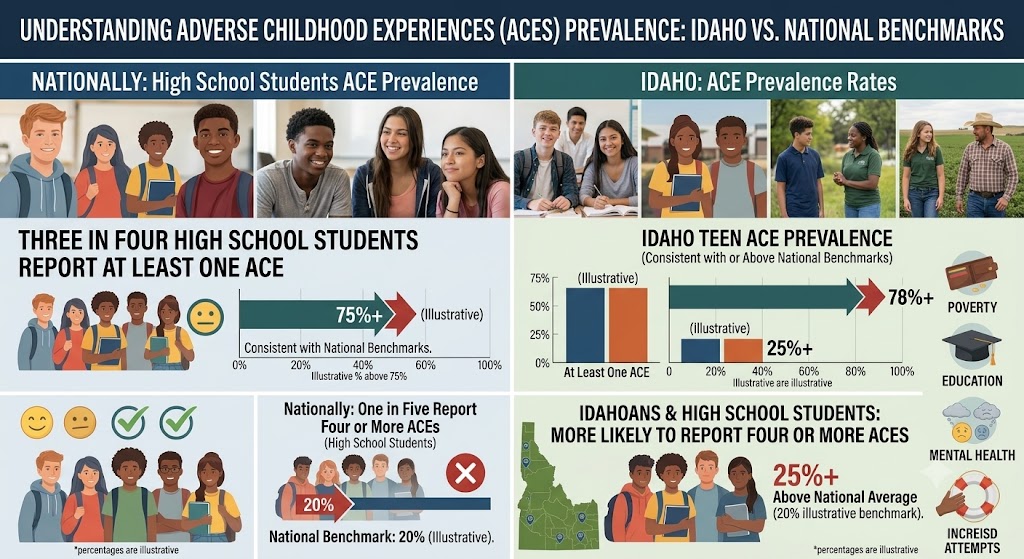
Idaho's ACE rates exceed the national average. Idahoans are more likely to report four or more ACEs than Americans overall. Nationally, three in four high school students report at least one ACE, and one in five report four or more. Idaho's numbers are consistent with or above these benchmarks. ACEs in Idaho are strongly correlated with poverty, lower educational attainment, mental health challenges, and suicide attempts. Rural Idaho faces unique challenges: geographic isolation, limited access to mental health providers, cultural barriers to help-seeking, and economic stressors. Idaho Youth Ranch has been serving Idaho families for more than 70 years and provides trauma-informed care across the state.

Idaho's ACE Data

Idaho's ACE Data: What the Numbers Show

What Idaho's numbers on adverse childhood experiences mean for local families

The Idaho BRFSS (Behavioral Risk Factor Surveillance System) conducted a comprehensive analysis of ACE data collected in 2020, examining both the occurrence of specific ACEs among Idaho adults and the relationship between ACEs and health-related outcomes. The findings confirm what Idaho-based providers have long observed: adversity is widespread and its effects are measurable.

Key findings from Idaho's data:

  • Idahoans are more likely to have experienced four or more ACEs than the national average
  • The most commonly reported ACEs in Idaho include household substance use, parental separation/divorce, and emotional abuse
  • Higher ACE scores in Idaho are associated with lower income levels — adults with more ACEs are more likely to live below the poverty line and less likely to have household income above $75,000
  • Higher ACE scores are associated with lower educational attainment — adults with more ACEs are less likely to have graduated from college
  • ACEs in Idaho are strongly correlated with poor mental health outcomes and significantly elevated rates of suicide attempts

How Idaho Compares to National Data

The 2023 Youth Risk Behavior Survey — the first national survey to collect self-reported ACE data directly from high school students — found that three in four U.S. high school students reported at least one ACE, and one in five reported four or more. The most commonly reported ACEs among adolescents nationally were emotional abuse, household poor mental health, and household substance use.

Nationally, about 61% of adults report at least one ACE, and nearly one in six report four or more. Idaho's adult data shows rates at or above these national benchmarks across most categories. This means that in any Idaho classroom, the majority of students have experienced adversity — and a significant minority are carrying the weight of four or more adverse experiences.

What Makes Idaho's ACE Picture Unique

Rural isolation

Idaho is one of the most rural states in the country. Many families live hours from the nearest mental health provider. Geographic isolation means that even when parents recognize their teen needs help, accessing that help requires significant effort — long drives, limited appointment availability, and few local options. This barrier delays intervention and allows the effects of adversity to compound.

Limited mental health workforce

Idaho consistently ranks among the states with the fewest mental health providers per capita. Many counties have no child or adolescent mental health specialist at all. This means families who are ready to seek help may face waitlists, limited provider choices, or the need to travel out of their region for care.

Cultural expectations around self-reliance

Idaho's culture values independence and self-sufficiency, which are strengths in many contexts. But when applied to mental health, these values can become barriers: parents may feel that asking for help is a sign of weakness, that their family should be able to handle its own problems, or that therapy is for other families, not theirs. This cultural dynamic delays help-seeking and allows adversity to accumulate without intervention.

Economic stress

While Idaho's economy has grown significantly, many families — particularly in rural areas — continue to face economic pressures that function as ACEs in themselves: food insecurity, housing instability, lack of access to healthcare, and the stress of working multiple jobs to make ends meet. These factors are not on the original ACE checklist but contribute to the same toxic stress pathway.

What This Means for Your Family

If you are reading this page, the data is not abstract. It is personal. Here is what the numbers mean at the family level:

You are not alone

The prevalence data makes clear that the majority of Idaho families are affected by adversity in some form. Whatever your teen is experiencing, other Idaho families are navigating the same challenges. The shame and isolation that often accompany ACEs are not warranted — this is a shared reality, not a personal failure.

Early intervention matters more here

Because Idaho has fewer mental health resources per capita than many states, the window for effective intervention is even more important to use. Teens who receive support during adolescence — when the brain is still plastic and responsive to treatment — have significantly better outcomes than those who wait until adulthood. The earlier you act, the more the investment pays off.

Idaho-specific resources exist

Idaho Youth Ranch has been serving Idaho families for more than 70 years. With locations across the state and experience in rural, urban, and suburban Idaho communities, IYR provides trauma-informed therapy that understands the specific realities Idaho families face. You do not have to leave your community to find help.

The data is a call to action, not a cause for despair

Idaho's higher-than-average ACE rates mean the need is greater — but the research is equally clear that positive experiences, resilient relationships, and evidence-based therapy can shift the balance. The same data that documents the problem also points toward the solution.

In any Idaho classroom, the majority of students have experienced adversity. This is not a rare problem affecting someone else's family. It is a shared reality — and the resources to address it exist here.

Sources: Idaho DHW BRFSS 2020 — ACEs dashboard; MMWR 2024 — YRBS ACEs prevalence (Swedo et al.); CDC BRFSS 2011–2020 — national ACEs prevalence; MMWR 2023 — ACEs among U.S. adults.


Frequently asked questions

Common questions
parents may have

Answers to some of the questions families often ask when trying to understand these challenges.

Why don’t coping skills always work?

The most common reasons: the skill does not match the function (a calming technique offered to a teen seeking sensation), the skill was introduced during a crisis rather than practiced beforehand, or the emotional intensity exceeded the skill’s capacity. When skills fail, it usually means the match or the timing needs adjustment — not that the teen is failing.

Why don’t coping skills always work?

The most common reasons: the skill does not match the function (a calming technique offered to a teen seeking sensation), the skill was introduced during a crisis rather than practiced beforehand, or the emotional intensity exceeded the skill’s capacity. When skills fail, it usually means the match or the timing needs adjustment — not that the teen is failing.

Why don’t coping skills always work?

The most common reasons: the skill does not match the function (a calming technique offered to a teen seeking sensation), the skill was introduced during a crisis rather than practiced beforehand, or the emotional intensity exceeded the skill’s capacity. When skills fail, it usually means the match or the timing needs adjustment — not that the teen is failing.

Frequently asked questions

Common questions

parents may have

Answers to some of the questions families often ask when trying to understand these challenges.

Where can I find Idaho-specific ACE data?

The Idaho Department of Health and Welfare maintains an interactive ACEs dashboard based on 2020 BRFSS data, available at gethealthy.dhw.idaho.gov. The dashboard includes statewide ACE prevalence, breakdowns by specific ACE categories, and correlations with health outcomes. The CDC's national ACE data is also available for comparison.

What if I live in a rural area with no local mental health providers?

Idaho Youth Ranch serves families across the state, including in rural communities. Telehealth options have expanded access significantly. Additionally, the resilience-building strategies in our deep guide — positive childhood experiences, developmental relationships, and predictable home environments — do not require a therapist and can begin immediately. When professional support is needed, IYR can help you find accessible options.

Does a high ACE score mean my teen will have problems?

Higher ACE scores increase risk, but they do not determine outcomes. The research consistently shows that positive childhood experiences, strong developmental relationships, and professional therapy can significantly moderate the impact. Many people with high ACE scores lead healthy, productive lives — especially those who received support during adolescence. The data describes risk, not destiny.

Why are Idaho's ACE rates higher than the national average?

Multiple factors contribute: Idaho's rural geography limits access to mental health services, cultural values around self-reliance can delay help-seeking, economic pressures affect many families, and substance use rates are significant across parts of the state. Importantly, higher ACE rates do not mean Idaho parents are worse parents. They reflect systemic factors that make adversity more likely and intervention less accessible.

Practical ways to turn what Idaho's ACE data tells us into action for your own family:

Understand the data without personalizing it as blame

Idaho's higher ACE rates reflect systemic conditions, not individual parenting failures. Understanding the data empowers you to act — it helps you see that your teen's struggles may have roots in adversity that is common across Idaho communities, and that effective responses exist.

Start building positive experiences now

The PCE research shows that positive childhood experiences can buffer against the effects of ACEs at every level. You do not need a therapist to begin. Consistent routines, emotional availability, community connection, and at least two caring non-parent adults in your teen's life are all things you can begin strengthening this week. See our resource: Building Resilience After Trauma.

Explore Idaho-based resources

Idaho Youth Ranch provides outpatient therapy, family counseling, residential care, and equine-assisted therapy across Idaho. Telehealth options are available for families in underserved areas. Contact us to explore what is accessible from where you live.

Connect with other Idaho families facing the same thing

You are not the only Idaho parent navigating the effects of adversity, even when it feels that way. Seek out other families who understand, whether through a support group, your faith community, your teen's school, or a local parenting network. Hearing how others respond to the same pressures can reduce the isolation and shame that often surround these struggles. Connection is not just good for your teen; it steadies you as the parent doing the work.

Explore helpful resources

Helpful guides and articles for families seeking more information and support.

should connect to any other Parent Resources articles.

Understanding the data is a start, and you do not have to figure out the next steps on your own. Idaho Youth Ranch offers outpatient therapy, family counseling, and equine-assisted therapy across the state, with telehealth for families in harder-to-reach areas.

Get Started

Idaho Families Deserve Idaho-Based Support

For more than 70 years, Idaho Youth Ranch has helped young Idahoans and their families heal from adversity. If your family is affected, help is closer than you think.

For more than 70 years, we've stood beside Idaho's youth and families.

Hope. Healing. Resilience.

Call Now

Speak with our Team directly.

Best for families who want to talk through next steps, ask questions, or connect with admissions for the Residential Center for Healing & Resilience.